Thickeners and Stabilisers: A Culinary Perspective
Nov 21, 2026

Written by
Simon LovedayMy favourite home-made chicken & corn soup recipe has a potato in it, and the soup is creamy and delicious. Potatoes are mostly starch and water, and during cooking the starch is activated (the technical term is ‘gelatinised’) and it makes the watery soup thicker – the recipe is using potato starch as a thickener.
The starch gives a creamy texture in the mouth, but it also keeps all the blended up bits of corn suspended. Without the potato, the corn particles would settle to the bottom and a watery layer would form on top – not so appealing! The starch from the potato is also acting as a stabiliser.
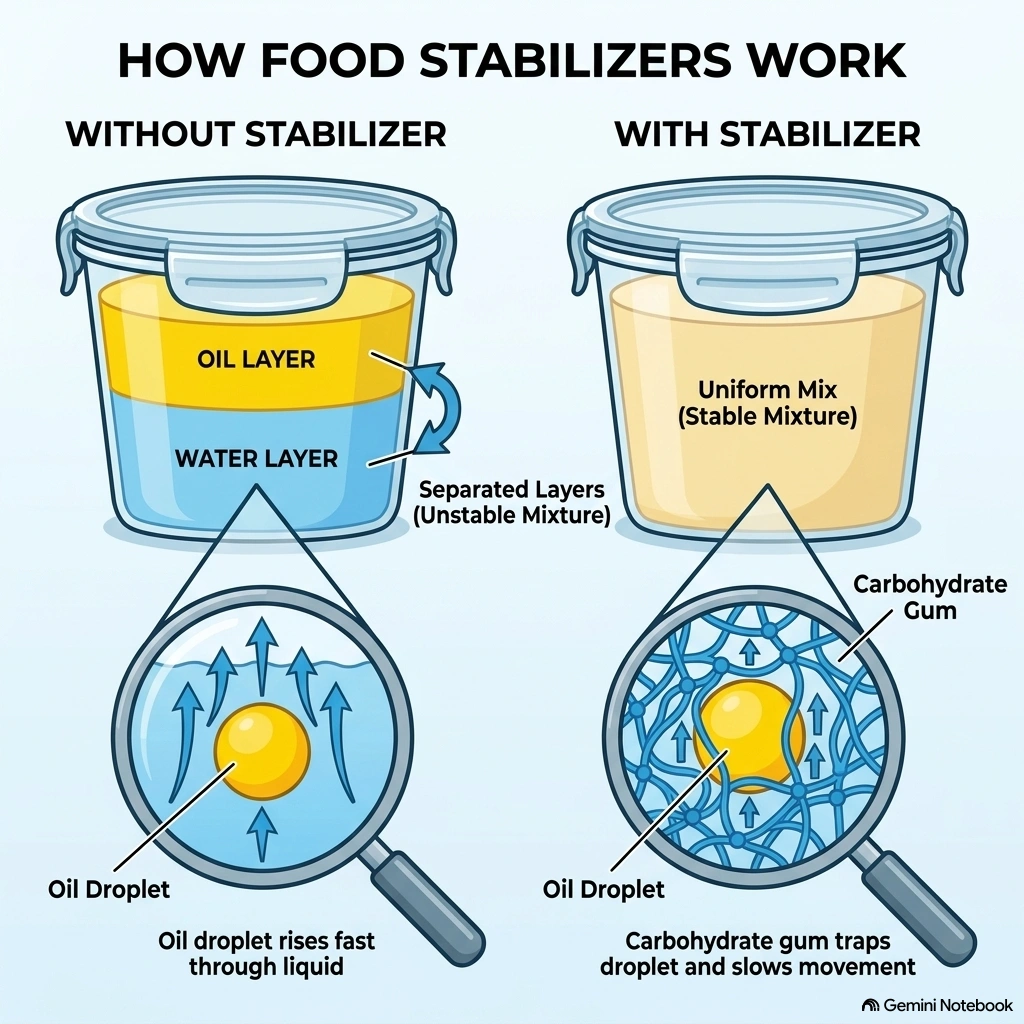
If I make a salad dressing with just oil and water then shake it up, it separates very quickly and I end up pouring mostly EVOO onto my rocket with blue cheese and toasted walnut. What’s happening after I stop shaking? Little droplets of oil are rising through the balsamic vinegar, dodging bits of ground black pepper, bumping into each other and coalescing, until there’s one big layer of oil on top.
My local wholefoods shop sells xanthan gum powder. Xanthan is a natural carbohydrate produced by fermentation. If I add a pinch of xanthan gum to the vinegar before adding oil and shaking it up, the dressing stays mixed for longer… not for ever but at least until lunch is over. Xanthan dissolves in the vinegar and slows down the oil droplets, thereby delaying separation – it’s acting as a stabiliser.
credit: Simon Loveday via Gemini Notebook
Lots of other natural carbohydrates are used to create a smooth, uniform texture in food. We get carrageen from seaweed, guar gum and locust bean gum from seeds, gum arabic from acacia tree sap, pectin from fruit peel, and starches from wheat, maize, potato and tapioca.
Why so many? That’s like asking a builder “why are there so many different kinds of screws?” I truly suck at do-it-yourself home handyman stuff, but I can guess that different kinds of screws hold together different bits of a house. Same with stabilisers – some are good for acidic foods, some for salty foods, others for milky foods and they all give a slightly different texture in the mouth.
I hope I’ve convinced you that chefs and home cooks are using stabilisers and thickeners, even if we don’t call them that in the kitchen. Is that different to ‘cosmetic’ thickening and stabilising ingredients in the recipes of foods that we buy from the store? I’m genuinely interested to know how you perceive the differences.